
Reconstruct Pierce County Owners
Each backward chain starts from one known transfer and turns every grantor into the next search name. Treat the table as a working timeline. It claims nothing about any specific parcel. Fill in a row only when the deed image and legal description support the match.
| Transfer date | Grantor to grantee | Deed type | Book/page |
|---|---|---|---|
| Newest recorded date | Prior owner to current grantee | As indexed and verified in image | Exact citation |
| Earlier recorded date | Earlier owner to prior owner | As recorded | Exact citation |
| Next earlier date | Earlier grantor to grantee | As recorded | Exact citation |
| Office or archive date | Names copied from older index | Verify from volume | Book/page or film |
Never skip a row just because two surnames look alike. A gift, estate, trustee, quitclaim, tax-sale, or deed-in-lieu instrument can reroute the chain, and the instrument's own land description always controls.
Go Back Through Pierce County Deeds
The GSCCCA Real Estate Index is the first online route. Keep Pierce County selected. It filters by party name, instrument, property, and date, and shows recorded images, so a cross-county switch needs support in the record itself.
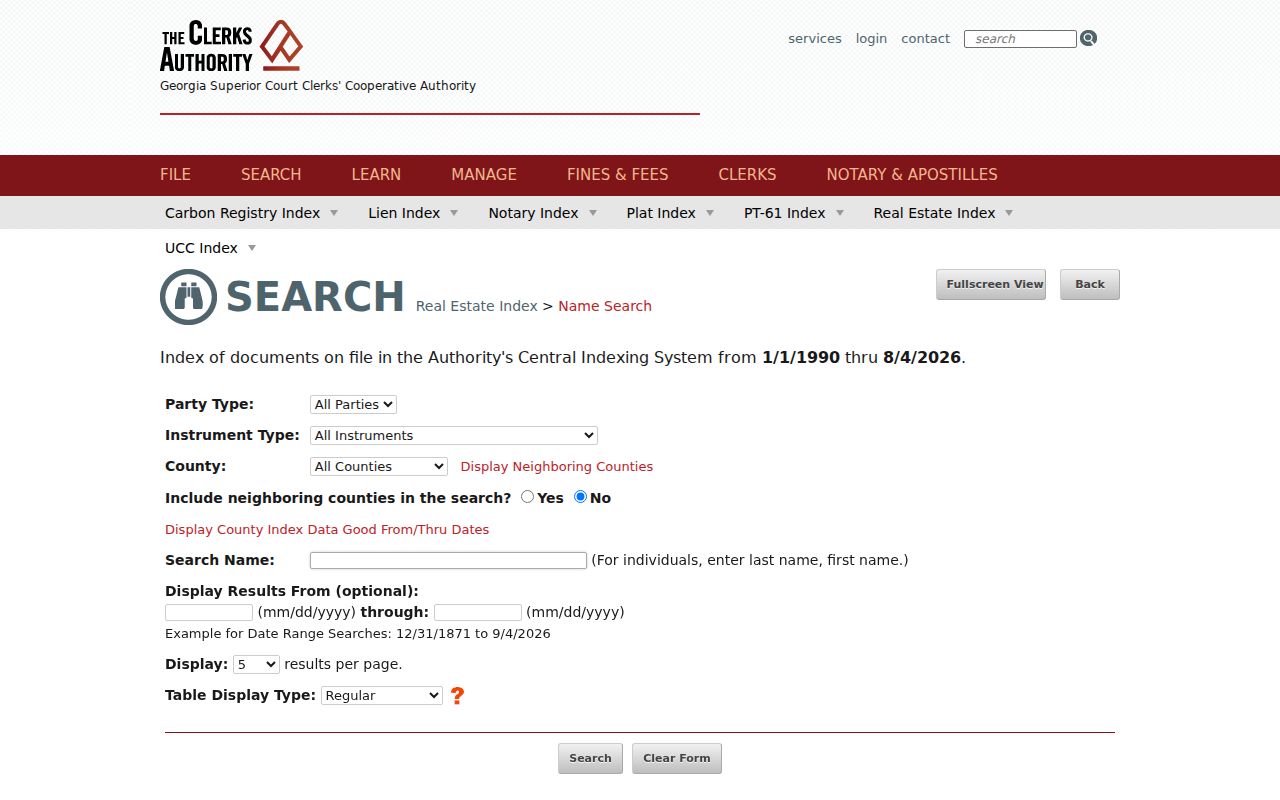
Log each county setting and search spelling. A saved search log keeps a later blank result from being mistaken for a proven gap in the deed chain.
- Find the current grantee's acquisition deed and save its date and citation.
- Read the grantor and copy the legal description exactly.
- Search that grantor as a grantee in an older Pierce instrument.
- Repeat while the land description and citations remain consistent.
- Move to books, microfilm, and archives when the online chain stops.
- Grantor
- The party conveying the stated interest.
- Grantee
- The party receiving the stated interest.
- Chain of title
- The ordered series of instruments affecting the land.
- Reverse index
- An index arranged to find parties from the opposite side of a transfer.
- Quitclaim and warranty
- Different deed forms whose precise legal effect must be read from the instrument.
Pierce County Owner Coverage Limits
GSCCCA's statewide system went live in 1999. The notice reaches back to 1990. That broader central date notice appears on the current name-search form, yet neither figure sets the earliest complete Pierce County deed or image year, and the exact Pierce cutoff is not posted.
Do not guess the first year. Treat the online notice as interface scope, then ask the Clerk which Pierce books, indexes, and images cover the period needed.
A blank result can mean many things. An older book, a spelling variant, a different instrument type, or a name indexed another way could all hide the deed. It never proves the land had no former owners.
Match Pierce County Owners Through Time
Street addresses make weak historical keys. Pierce records identify land by land lot, land district, and GMD. Subdivision, lot, block, acreage, or plat citation also identify land. One rural parcel carried no street number at all. Its raw string, LL170 LD5 PL1-21, should be preserved as written. Do not expand it by assumption.
Compare the deed's legal description with the assessor string and plat image character for character. Parcel numbers change after splits or combinations. Road names, rural routes, postal cities, and city limits shift too. The legal land description remains the stronger bridge across all of that change.
Transfers That Bend Pierce County Chains
A simple purchase deed makes a clean link. Other events do not. Executor deeds, trustee deeds, gift deeds, tax deeds, quitclaims, security deeds, foreclosure instruments, and death affidavits all need added context. Read the image, not just the index label. Georgia commonly finances real estate through a security deed, and a later satisfaction or release closes that encumbrance without changing the owner. Separating transfers from financing records keeps a lender off your list of previous owners.
Probate Bridges Pierce County Owners
A death opens a Pierce Probate Court file. It may name the decedent, the executor or administrator, heirs, a property schedule, a petition to sell, and the final order, which explains why the next deed was signed in a representative capacity. Treat the allegation or inventory as context. The recorded transfer remains the chain's endpoint.
The Pierce Probate Court publishes no searchable online docket. Contact the office, visit the counter, or send a focused request with the decedent, an approximate death date, the parcel number, and the legal description. Access limits may protect some estate, guardianship, or conservatorship material.
The 1875 Pierce County Owner Fork
Pierce County formed in 1857. Its first Blackshear courthouse went up the next year and burned in 1875. That fire is a reason to test book-level continuity, not a license to declare every early record lost. A pre-fire deed may have survived elsewhere, been recopied, been re-recorded, or been recited in a later instrument.
Run parallel searches when a chain reaches that era. Continue with the Clerk's index and volumes. Also check the Georgia Archives county card. Add microfilm collections and the FamilySearch catalog. County tax digests, probate material, and later deeds can supply leads, though only the recorded instrument establishes the transfer.
Extend Pierce County Previous-Owner Research
The Georgia Archives Pierce county card is a finding aid. It is not a deed database. Archives guidance places many pre-1900 county materials at Archives or FamilySearch, while later records usually route to the local Superior or Probate clerk. Search catalogs by place, title, surname, call number, and film number.
At the Clerk's office, request the historical grantor and grantee indexes, the named deed book and page, and any available image or copy. Mail works too. A Georgia Open Records Act request should carry a narrow date range and an exact citation, and asking for an electronic copy with a fee estimate saves time. These fallbacks matter when records sit offline.
Limits on Pierce Former Owners
A deed chain is only as sound as its parcel match and its unbroken citations. Same-name hits, tax-roll entries, newspaper notices, and family-history sources can guide you. They cannot fill a missing transfer. The mechanics for pulling an individual image sit with Pierce County deed records.
Use history with care. Former-owner research serves title review, house history, estate work, and purchase diligence. Never use past or current owner data to harass or target a person.
An honest gap beats a confident but unsupported chain.